


EMISSION CONTROL
Air Quality and Health Effects:
Engine and Vehicle Emissions
If we could burn petrol or diesel perfectly in pure oxygen it would produce only carbon dioxide (CO2), water vapor, and energy. However in reality there are always some emissions of unburned and partially burned fuel, giving carbon monoxide (CO), hydrocarbon (HC) and - especially for diesel engines - particulate matter (PM), plus nitrogen oxides (NOx) formed from nitrogen present in the air.
Motor vehicles have played a major role in urban air quality problems and consequent health effects due to these emissions. Although kerbside, 'street canyon' (streets surrounded by high buildings) or local emissions are of particular concern because the concentration of pollutants is likely to be highest in these situations, effects can also occur away from city or town centers as the pollutants react with each other and are distributed by air movement.
Health Risks From Vehicle Pollution
Carbon monoxide (CO) is a poisonous gas that displaces oxygen from the blood. At high concentrations it is fatal; at lower concentrations, it can exacerbate heart problems.
Hydrocarbons (HC) are mostly relatively harmless themselves but help form photochemical smog in the atmosphere. Some HCs, such as benzene, are known carcinogens.
Nitrogen oxides (NOx) react with hydrocarbons in sunlight to form harmful ozone and photochemical smog. NOx can increase respiratory illnesses and is a contributor to acid rain. Ozone causes breathing difficulties and damages plants.
Particulate matter (PM) is mainly soot particles with volatile hydrocarbons and some sulfate and metallic residues from the fuel and engine lubricant. Particles are found in the air in a range of sizes. Diesel engines are responsible for the majority of ultra-fine particulates (less than one micron in diameter or PM1). These small particles (mostly below 100 nanometers diameter) are present in large numbers in untreated exhaust, but amount to only a tiny fraction of the weight of particulate matter. There is evidence that fine and ultra-fine particles are linked to increased rates of premature death for causes such as cardiovascular and lung disease.
Carbon dioxide (CO2) is the final product of all combustion processes and the major contributor to the 'greenhouse' effect. Catalysts do not increase overall CO2 emissions from cars because all the carbon burnt in the engine eventually ends up as CO2, so CO2 emissions can only be limited by reducing the amount of fuel used. Use of particulate filters or NOx traps gives a small (typically 1 to 2%) increase in CO2 because a small amount of extra fuel is used to regenerate them from time to time, but Selective Catalytic reduction (SCR) can reduce fuel consumption and hence CO2 by up to 5% by allowing engine developers to use more fuel-efficient conditions instead of trading fuel consumption for a reduction in combustion NOx emissions.
Lead was, in the past, added to petrol to boost the octane number. Health concerns focussed on the effect that low levels of ambient lead can have on the educational and behavioural development of children. Lead poisons catalytic converters and since 2000, sales of leaded petrol have been banned in the European Union. For the remaining non-catalyst engines that rely on lead to prevent valve recession, other additives have been introduced.
Controlling Engine and Vehicle Emissions:
The Integrated Approach
Catalyst and filters are part of a complete system, where all the elements must work together to achieve the greatest possible reduction in emissions. The fuel and fuel system, the engine and its combustion system, sensors and the design and location of the catalyst and filter combine with the electronic control system to give the maximum emissions reductions. Logical Trading Company therefore works closely with the automotive manufacturers and their system suppliers to achieve these goals.

The Sources of Pollutants
If we could burn petrol or diesel perfectly in pure oxygen it would produce only carbon dioxide (CO2), water vapour (H2O), and energy. However in reality it is never possible to burn fuels perfectly, so there are always some emissions of unburned and partially burned fuel together with oxides of nitrogen (NOx) from the nitrogen in the air.
Fuel, whether it be petrol, diesel, natural gas (CNG) or LPG is made up of hydrocarbons. These can range from small, simple molecules such as methane, the main component of natural gas, to large complex molecules. In combustion these molecules get broken up. Ideally they break down completely to CO2 and water vapour, but some escape unchanged or partially degraded as hydrocarbons (HC) or as carbon monoxide (CO). For diesel engines especially some of the fuel ends up as particulate matter (PM). PM is mainly soot particles with volatile hydrocarbons and some sulfate and metallic residues from the fuel and engine lubricant. The other main pollutant in exhaust gas results from the fact that we burn the fuel in air, which is nearly 80% nitrogen, not in pure oxygen. At high temperatures, the nitrogen forms nitrogen oxides (NOx) in the combustion chamber. The more efficient the combustion, the higher the temperatures are likely to be and hence the higher the NOx emissions.
The Role of Catalysts, Filters and Absorbers
Control of the fuelling and combustion processes offer a method of giving some reduction in engine-out emissions. Mechanical systems such as Exhaust Gas Recirculation (EGR) also offer the engine designer some opportunities to reduce specific emissions under appropriate operating conditions; for instance EGR re-uses some of the exhaust gas so as to lower the combustion temperature and reduce engine-out NOx emissions. Autocatalysts, traps and filters as part of a correctly-designed engine system can virtually eliminate pollutants under most driving conditions. Catalysts generally need to reach a suitable operating temperature, but with modern systems this is reached within seconds.

Fuel Quality for Catalyst, Rrap and Filter Performance
The quality of the fuel used can assist or degrade the performance of emission control systems. Lead has long been recognised as a catalyst poison as well as having impacts on human health, and is no longer permitted in European fuels. There are concerns over the use of other metallic additives, with suggestions that their use in gasoline may, under some driving conditions, lead to deposits on exhaust system components such as the oxygen sensor and catalyst. Metallic or other ash-forming materials in diesel fuel will add to the amount of ash captured by particulate filters and may require the system to be designed so as to allow for the additional ash. Detergent additives, on the other hand offer positive benefits. Their use helps keep the fuel injection system and combustion system clean, so helping to prolong optimum operating conditions for the emissions control technology. Sulfur in petrol and diesel fuel has a major negative impact on catalyst performance and in diesel also contributes to the mass of particulate matter (PM). The effect of sulfur on catalyst performance becomes more critical as lower tailpipe emissions are targeted and the loss of catalyst efficiency caused by sulfur in the fuel has a greater impact at the very low emissions levels required in future.
Sulfur strongly competes against pollutants for 'space' on the catalyst surface and this limits the efficiency of catalyst systems to convert pollutants at any sulfur concentration. The effect of sulfur as a competitor on the catalyst surface may be reversible but it can cause irreversible changes to the washcoat and some of the base metal components. The conversion of sulfur to a sulfate aerosol can cause net increases in particulate emissions. One tankful of high sulfur fuel will immediately degrade catalyst performance but this will normally be restored on reverting to a low sulfur fuel. The levels of sulfur in fuel are an important factor in the performance of most NOx catalysts and adsorbers. The lower the sulfur levels in fuels the better the catalyst performance that can be obtained. For this reason European legislation already limits road fuel sulfur content to 50 parts per million (ppm), with 10ppm (max.) having to be available since 2005 and to be fully introduced in 2009.
Introduction to the Technology for Cmissions Control:
Catalytic Converters
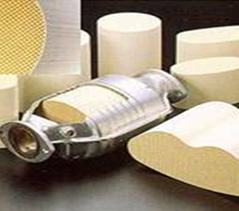
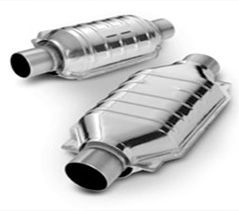
The term covers the stainless steel box mounted in the exhaust system. Inside is the autocatalyst - a ceramic or metallic substrate with an active coating incorporating chemical compounds (the washcoat) to support a combination of catalytical materials or minerals selected for their effectiveness in the required emissions reductions. It can also be a homogeneous honeycomb ceramics in which only active compounds are extruded simultaneously. The autocatalyst is mounted in a can and is protected from vibration and shock by a resilient 'mat'. The catalytic converter then looks similar to an exhaust muffler. The different types of autocatalysts are described in more detail on the catalyst page.

Particulate Filters
Based on engine technology and application specificities, different filter technologies may be used to reduce particles emissions. The 'wall-flow' filter is a ceramic substrate in which the gas is forced to flow through the walls, thus filtering out particulate matter with more than 99% efficiency. It is aslo mounted in a stainless steel can and protected by a resilient mat. These filters can also have an active coating similar to that used in autocatalysts to ensure their regeneration. Fuel-borne catalysts or engine calibration measures can also be used for the necessary regeneration.
The 'partial-flow' filter is a device which typically separates 30 to 60% of the partuclates from the exhaust gas. These filters are available in various materials, from metallic to fiber-based.

Substrates
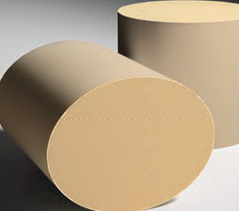
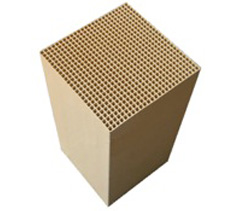
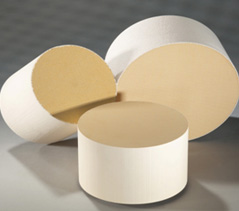
The substrates on which the active catalyst is supported can be ceramic or metallic, with each offering particular advantages for specific applications and positions in the exhaust system. The development of strong ultra-thin wall substrates with cell densities of up to 1200 cells per square inch (186 cells/square cm) has been a major factor in the increasing efficiency of autocatalysts.

The technology of the substrates on which the active catalyst is supported has seen great progress. In 1974, ceramic substrates had a density of 200 cells per square inch (cpsi) of cross section (31 cells/cm2) and a wall thickness of 0.012 inch or 12 mil (0.305 mm). By the end of the 1970s, the cell density had increased from 300 to 400 cpsi and wall thickness had been reduced by 50% to 6 mil. Now 400, 600 and 900 and even 1200 cpsi substrates are available and wall thickness can be reduced to 2 mil - almost 0.05 mm. In parallel, in the late 1970s, substrates derived from ultra-thin foils of corrosion-resistant steels came on to the market. In the beginning, the foils could be made from material only 0.05 mm thick allowing high cell densities to be achieved. Complex internal structures can now be developed; 800 and 1000 cpsi metallic substrates are available and their wall thickness is down to 0.025 mm. This progress in ceramic and metal substrate technology has major benefits. A larger catalyst surface area can be incorporated into a given converter volume and this allows better conversion efficiency and durability. The thin walls reduce thermal capacity and limit pressure losses. Alternatively, the same performance can be incorporated into a smaller converter volume, making the catalyst easier to fit close to the engine as cars are made more compact.
Catalytic Coatings
Coatings systems have been developed which allow the maximum efficiency with optimum use of the precious metals platinum (Pt), palladium (Pd) and rhodium (Rh). The nanotechnology used in catalytic coatings involves stabilised crystallites, washcoat materials that maintain high surface area at temperatures around 1000ºC, improved oxygen storage components and novel coating processes to optimise the distribution of the coatings. All play a part in the high efficiencies of autocatalysts.